


How a Beer Commercial Became Mexico's Best Collectable Poster

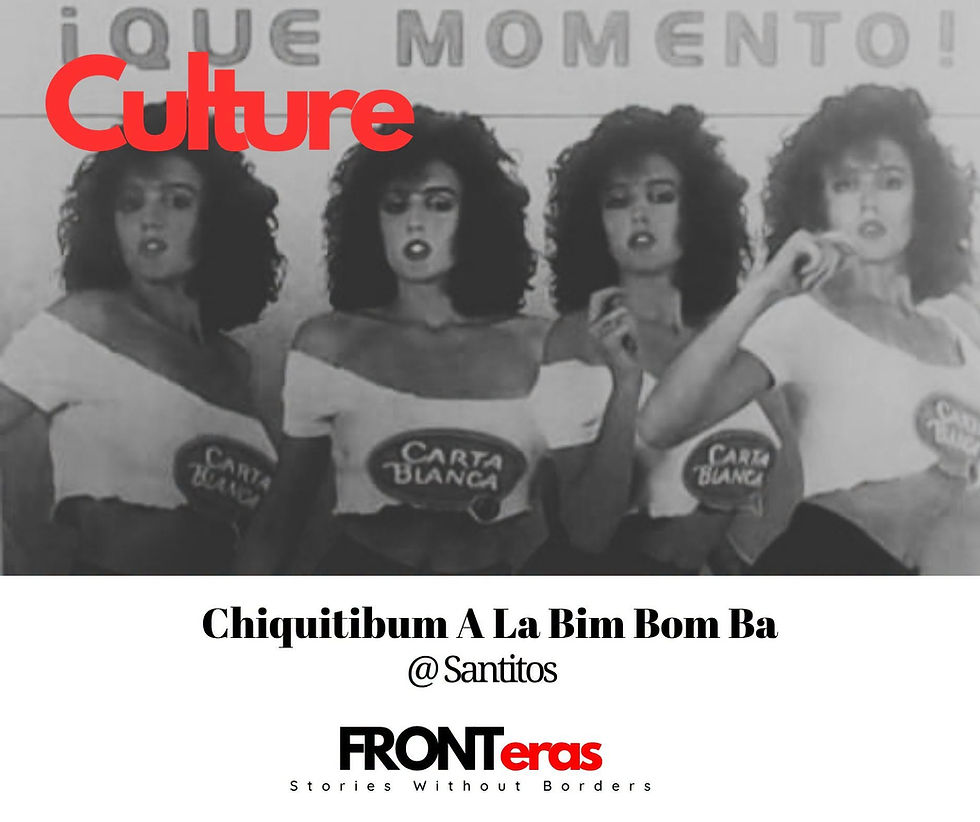
A young woman in a cropped white Carta Blanca shirt holds the FIFA World Cup trophy with both hands, brown curls falling loose around her face, the crowd at Estadio Azteca blurred behind her. She is grinning. She is in her early twenties. Forty years later, the image still moves through social media feeds the same way it moved through television sets in 1986.
Her name is Mar Castro. Everyone called her La Chiquitibum.
She appeared in a Carta Blanca beer commercial during the 1986 World Cup, and the appearance launched her to national fame and turned the chant "Chiquitibum a la bim bom ba," a traditional Mexican celebratory porra, into the sound of the tournament. Castro became its human face overnight. She did this without kicking a single ball, without a government platform, without Televisa building her a segment. She showed up in a crop top and she became the body of the summer.
Mexico was never supposed to host that summer. Colombia had been selected as host nation in 1974 and pulled out in October 1982, citing economic crisis and infrastructure shortfalls. FIFA handed the tournament to Mexico with barely three years to prepare and a national economy already hemorrhaging from the 1982 debt crisis. The Mexican national debt had ballooned from $6.8 billion in 1972 to nearly $60 billion by 1982. IMF austerity requirements followed. The country accepted the tournament anyway.
Before the vote on Mexico's candidacy, FIFA had secretly awarded broadcast rights to Televisa, the Mexican television network with a seat on FIFA's executive committee. The PRI government then used the tournament as an international PR operation transmitted through the same broadcaster. Projecting stability and modernity to foreign investors was the explicit goal. The people living through it got a different version of events.
A magnitude-8.1 earthquake struck Mexico City in 1985, barely eight months before the opening kickoff. Thousands of people died and tens of thousands lost their homes. Significant public protest followed over state funds flowing toward the World Cup while earthquake relief lagged. When President Miguel de la Madrid opened the 1986 World Cup ceremonies, fans booed, whistled, and shouted at him from the stands, a public rebuke so sharp it would have been unthinkable a decade earlier under the same party.
FIFA did not make conditions easier. Matches kicked off at noon and 4 p.m. in brutal heat, scheduled to optimize European television viewership rather than the experience of players or the 2.4 million fans who attended 52 matches across twelve stadiums. Mexico absorbed those conditions and put 114,600 people in Estadio Azteca for the final. The stands also produced something nobody planned: the La Ola, the wave, rippling through the crowd and then through global television broadcasts until a crowd ritual became international sports vocabulary. Mexico did not invent it, but Mexico broadcast it to the world.
Carta Blanca released its commercial into all of this.
Castro was an actress trained in dramatic arts who took the commercial gig through publicist friends, with no expectation of what would follow. The cropped shirt was no styling decision. The shirt was too small, so the production team cut it on set. Stadium fans who attended matches scanned the bleachers looking for her, unaware the scenes had been filmed with extras before the tournament began.
Fans arriving at Estadio Azteca expected to find her in the crowd. She ended up on national television being interviewed by Jacobo Zabludovsky on "24 Horas," the most-watched news program in Mexico at the time, to confirm she was a real person.
For the next four years, Carta Blanca sponsored Castro on a tour across Mexico. She was the distraction that Mexico needed.
Mexico in 1986 was still pulling itself out of a catastrophic earthquake while its government spent public money on stadiums. Castro and the commercial gave the public something to attach collective enthusiasm to with no connection to any of it. A nation carrying all of that turned a beer ad into a cultural touchstone.
Mar Castro is now around 60 years old and lives in Los Angeles. The four years after the commercial kept her on the road across Mexico, sponsored by Carta Blanca, while she quietly built an actual acting career alongside the beer tour. She appeared in the film A garrote limpio in 1986, the telenovela El camino secreto that same year, Lamberto Quintero in 1987 alongside Antonio Aguilar, and Dos vidas in 1988. She also appeared in the films Love and Basketball, Black Down, and La chica de la piscina. She also runs her own production company.
Forty years later, none of that is what people search for when her name comes up.
The FIFA trophy in the photograph weighs about eleven pounds. Castro held it with both hands. Argentina won it. Mexico never got near it. The image surviving from the tournament is a young woman from Málaga, in a Carta Blanca shirt, holding the cup like it belonged to her.
@Santitos
@salinasmariasantos
Copyright © 2026 Maria Santos Salinas for FRONTeras.
All rights reserved. This material may not be published, broadcast, rewritten, or redistributed without permission. Sharing the original posts or links from FRONTeras on social media is allowed and appreciated.
Comments