


Learning Curve


Osiel Peña swept floors for Coca-Colas.
He was a kid in Miguel Alemán, Tamaulipas, watching a neighborhood carpenter turn chunks of wood into chairs, tables, doorframes. The shop owner let him hang around if he kept the sawdust off the floor. Payment came in glass bottles, preferably tall and cold. Eventually, the Cokes turned into pesos. By then, Peña wasn't just sweeping anymore.


He had already been primed for this. His maternal grandfather, Primitivo Silva, was a self-taught carpenter who built furniture with his bare hands and whatever tools he could scrounge. Peña watched him work, mesmerized by the transformation of raw material into something useful, something beautiful. When his family moved from Los Treviños to Miguel Alemán at age seven, that fascination found a home in the carpenter's shop down the street.
Peña is the youngest of seven kids born to María and Ovidio Peña. His siblings—Ovidio, Orlando, Otonel, Oneida, Orfelinda, and Odilia—all knew what poverty looked like. They also knew what hunger for something better felt like.
In 2003, Peña and his wife Clara came to Texas with their daughter Josselyn. They lived in La Rosita in a borrowed room. Two years later, he got hired at Starr Moulding, the same place where he used to buy materials back when he was working as a carpenter in Mexico. Now he was on the inside. He moved to Campos Construction after that, sharpening skills he'd been building since childhood.
When his twin daughters, Itzel and Gisele, were born, Peña opened his own shop in Frontón in 2009. Self-employment introduced exponential risk, relentless pressure, interminable nights calculating margins and material costs. Clara anchored him. He overthinks compulsively. She operates with measured composure. That equilibrium rescued him more times than he'll acknowledge.
Peña knows what people think. Carpentry is manual labor. It's blue-collar work. It's what you do when you can't do anything else.
"Many young people, I think, look at this career as a low-level job," he says. "But when you learn how to do it right, it's something that can be very lucrative."
Carpentry is a skilled trade. It requires precise measurements, tool mastery, and an understanding of how materials behave under pressure. It's a talent which is often undervalued. "It's not just about building things," he explains. "When things break, you have to know how to fix them."
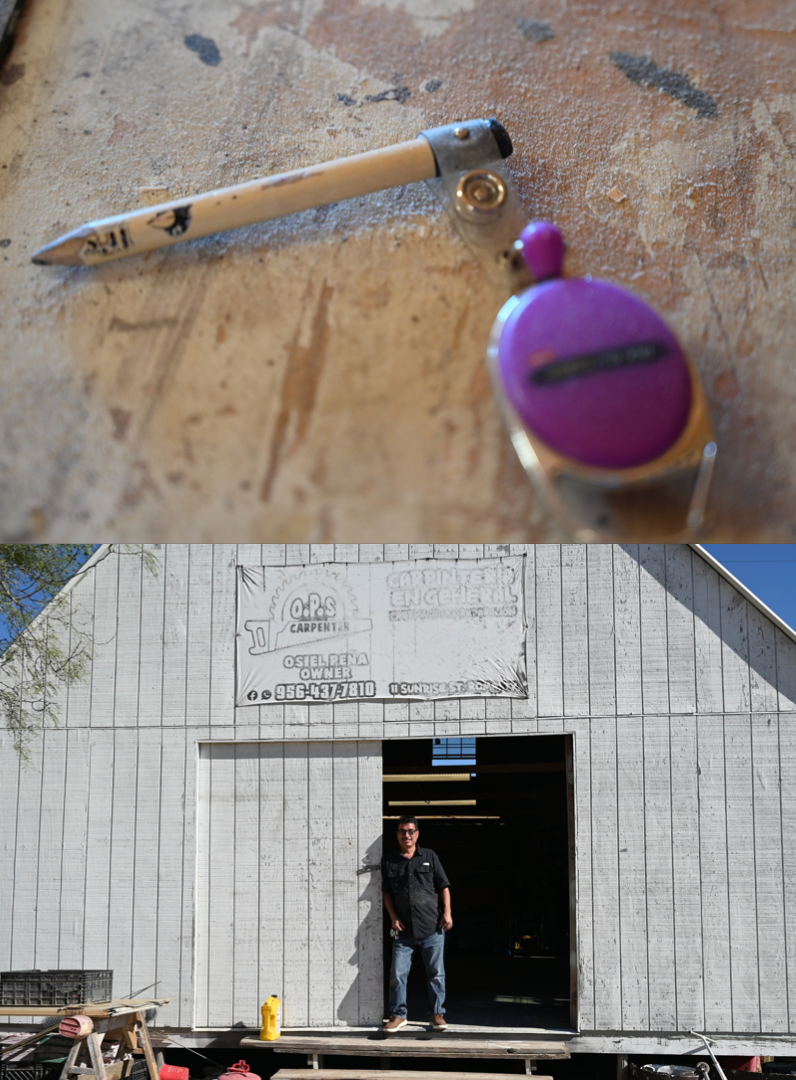
His grandson has no interest in learning the trade. Itzel and Gisele are enrolled at UTRGV now, pursuing education and criminal justice. Nobody's reaching for the tools.
He harbors no resentment about it. His legacy isn't about passing down techniques or teaching someone how to measure twice and cut once. His legacy is waking up every morning and doing work that matters to him. Most people spend their lives chasing that. Peña's been living it since he was seven years old, broom in hand, watching wood transform into something else.
@Santitos
@salinasmariasantos
Copyright © 2025 Maria Santos Salinas for FRONTeras.
All rights reserved. This material may not be published, broadcast, rewritten, or redistributed without permission. Sharing the original posts or links from FRONTeras on social media is allowed and appreciated.
Comments