


My Mother's Apron and the Life She Lived in It

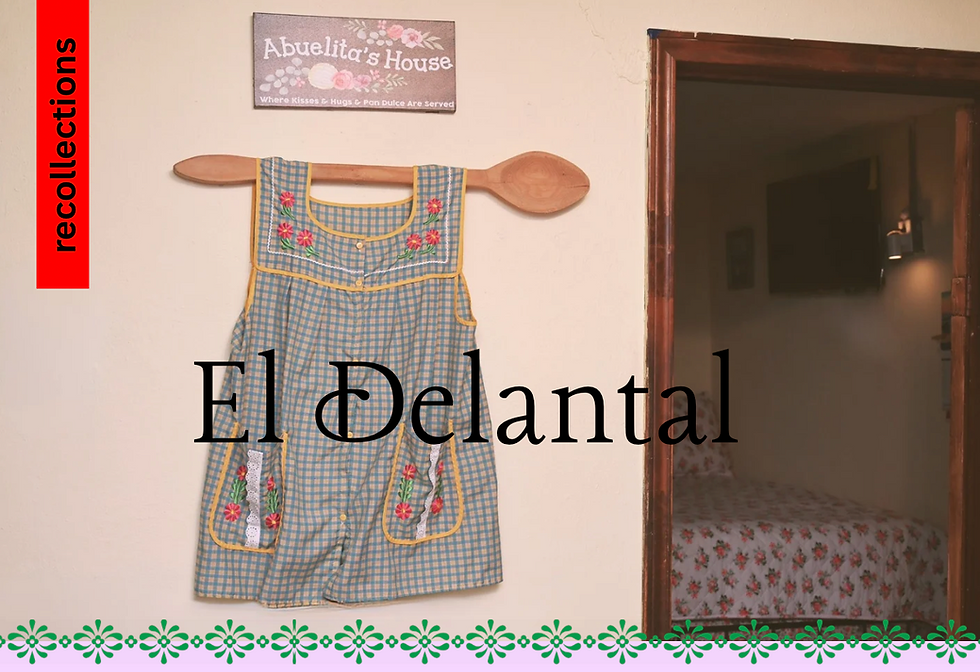
My mother lived in her kitchen. She would stand at the counter with her hands buried in masa, lard under her fingernails, and always—always—a novela volume turned up loud enough to hear from the living room.
Her aprons were iconic. She'd rotate through them like they were haute couture, matching her mood or the meal or whatever cosmic force guided her wardrobe decisions that day. She had one that looked like something June Cleaver would wear. She had one with pink flowers. Another one with yellow embroidery. Her favorite one was the purple one with the grapes. All of them unmistakably Mexican, the kind you'd find at the pulga wrapped in plastic bags.
The word delantal carries its purpose in its name. Derived from the Spanish word delante—meaning "in front"—the garment is literally defined by its position on the body. It comes from the Latin ante, "before," a linguistic reminder that protection has always required something standing between us and the mess we're about to make.
I'd sit at the table doing homework or pretending to do homework, watching her work. She never measured anything. A handful of flour. A pinch of salt. Her hands were measuring spoons.

The tortillas would hit the comal with that specific sizzle that meant dinner was close. She'd flip them without looking, her timing perfect, each one puffing up like a small miracle. I used to think all mothers had this superpower. That every kitchen operated on the same magic frequency of lard, love, and laughter.
She was a Goddess in the kitchen. She made carne guisada. Caldo de res. Her mole took two days. Tamales in October. Empanadas de calabaza in November. Buñuelos in December. She was a five-star chef.
Her corn tacos de fideo were my favorite. Food was simple. Food was love. Food was how she won every argument without saying a word.
She'd stand at that stove for hours, one eye on whatever was simmering and one eye on Televisa, and somehow she always knew exactly what was happening in both.
For years, I thought that kitchen was her cage, but now I understand that my mother wasn't trapped. It was her studio, her sanctuary, her territory. That kitchen belonged to her in ways the rest of the house never did. She ruled that space. She knew where everything lived, could tell by smell alone when something was burning, moved through it with her eyes closed.
I can still picture her in those aprons. The way she'd wipe her hands on them absently.
I can cook, but I can't recreate my mother's magic. None of us can get it right. We're missing some essential ingredient that only existed in her hands. And in her armor, her apron.
Her delantal always smelled like Suavitel. Now the house is empty. That scent is a memory. I walked through it last week and the silence felt like violence. Her apron hangs on her kitchen wall like a piece of art.
She's gone and the kitchen feels like a museum.
She left us the best of herself in that kitchen. In that apron hanging on the wall. In the seasoning permanently baked into her cast iron. In the way the whole house still smells faintly of cumin if you stand in the kitchen long enough.
@Santitos
@salinasmariasantos
Copyright © 2026 Maria Santos Salinas for FRONTeras.
All rights reserved. This material may not be published, broadcast, rewritten, or redistributed without permission. Sharing the original posts or links from FRONTeras on social media is allowed and appreciated.
FRONTeras is an independent publication protected by the First Amendment's guarantees of freedom of speech and freedom of the press. Our reporting and commentary draw from documented facts, public records, court filings, and reliable news sources. Opinions expressed in editorials are solely those of the author and do not constitute legal advice, divine truth, or the official position of FRONTeras. All articles, whether news, satirical or commentary, are produced according to journalistic standards of accuracy, fairness, and independence. While errors in reporting are possible, they will be corrected promptly once verified with credible sources. Critiques are grounded in evidence, not malice. Attempts to censor, intimidate, or punish the press will not alter the facts we publish. FRONTeras will continue to report without fear or favor.
Comments