


The Advice She Wanted Never Made It Past Her Eye Color

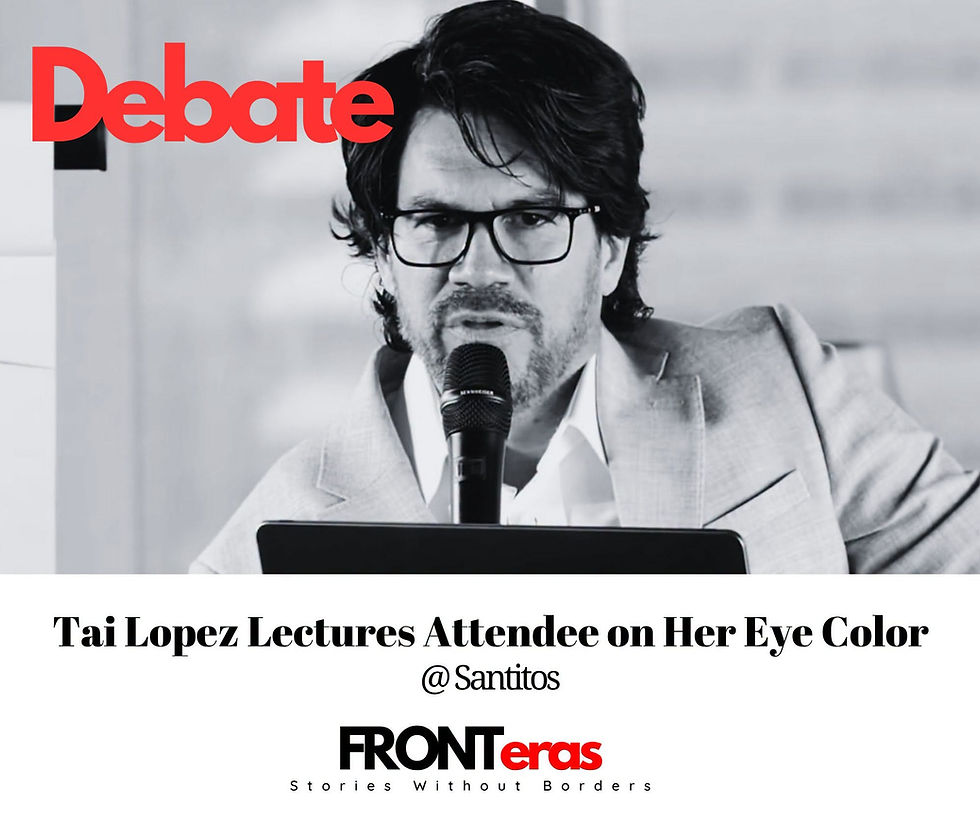
A woman stood up at a Tai Lopez event, microphone in hand, and asked a question common among small business owners: whether to focus on building her marketing agency or her personal brand.
Lopez responded by asking to see her dominant hand, fingers pressed together. He then asked her name. She said it was Mildred, and that she goes by Millie. He asked her where she was from. She said she was Mexican.
"Are those your real eye color?" he asked her. She admitted to wearing colored eye contacts, and out of nowhere, the man went off the rails.
"Mexican, there are nothing Mexicans love more than blue or green eyes. By the way, that's a racist theory that I agree with. Latin Americans were too affected by colonial blonde hair, blue-eyed, so they're so self-loathing. Nobody's more self-loathing than Latin Americans. If you have fucking blue eyes, you're like fucking royalty. I don't like, I love Latin America, but I hate that. You shouldn't be self-loathing. It is fine. Latin Americans, my first advice for you, don't wear those contacts."
Lopez's delivery drew criticism, but the underlying claim he was making is based on a real body of research. Colorism within Latin American communities has been studied by sociologists for decades, with research tracing preferential treatment tied to lighter skin and eyes back to colonial-era racial hierarchies in countries including Mexico, Brazil, and Colombia.
The term "pigmentocracy" was coined by Chilean anthropologist Alejandro Lipschutz in 1944 to describe this hierarchy, and later large-scale surveys across eight Latin American countries found that darker skin color consistently correlated with lower educational attainment, independent of a person's self-identified ethnic or racial category. Researchers involved in that work also found that discrimination based on skin tone was widely reported by both those who experienced it and those who witnessed it happening to others.
Lopez continued, "You don't understand that it's a negative legacy of Latin American colonial imposition of values. It happens in Brazil, it happens in Mexico, it happens in Colombia. It happens essentially everywhere, but Latin America has that disease where literally, if you have lighter skin, you could be ugly as fuck, but you're like loved. I don't think that's good. I think it's unhealthy."
Racist or not, Lopez turned that research into a public interrogation of one woman's contact lenses in front of a room of strangers who paid to hear about marketing funnels. Lopez called his own framing racist and agreed with it in the same breath, which is a rhetorical trick, not an insight. Saying something ugly out loud doesn't make it less ugly just because it's theorized.
Lopez has been described as a central figure in what industry critics call the "fake guru" phenomenon: coaches whose income comes mainly from selling courses and event access rather than from the business practices they teach. The exchange took place inside that structure, at an event where access to Lopez was the product, and where the answer to that question was supposed to be the payoff.
Worth pointing out: Lopez rose to prominence in 2015 through a viral advertisement in which he stood beside a Lamborghini and pitched knowledge as more valuable than material wealth, a video that helped launch a business built on online courses and personal branding. In late 2025, the Securities and Exchange Commission charged Lopez and a business partner with orchestrating a $112 million Ponzi scheme through their company, Retail Ecommerce Ventures.
A woman named Millie came to the microphone with a business question and left having answered questions she never asked, in front of an audience that watched the shift happen in real time. Her discomfort was visible. There is a time and place for conversations about whitewashing. A stranger cornered at a microphone, mid-question, without her consent, was not the time or place.
@Santitos
@salinasmariasantos
Copyright © 2026 Maria Santos Salinas for FRONTeras.
All rights reserved. This material may not be published, broadcast, rewritten, or redistributed without permission. Sharing the original posts or links from FRONTeras on social media is allowed and appreciated.
Comments